- Black Body Radiator
- Thermal and Cold Light
- Spectral Sensitivity of Human eye
- V(λ) Filter
- Photometric Units
- Calibrated Radiometer
- LED Light
- Incandescent Light
- Energy Saver Lamp
PE-1300 Radio-and Photometry of Light
Topics:
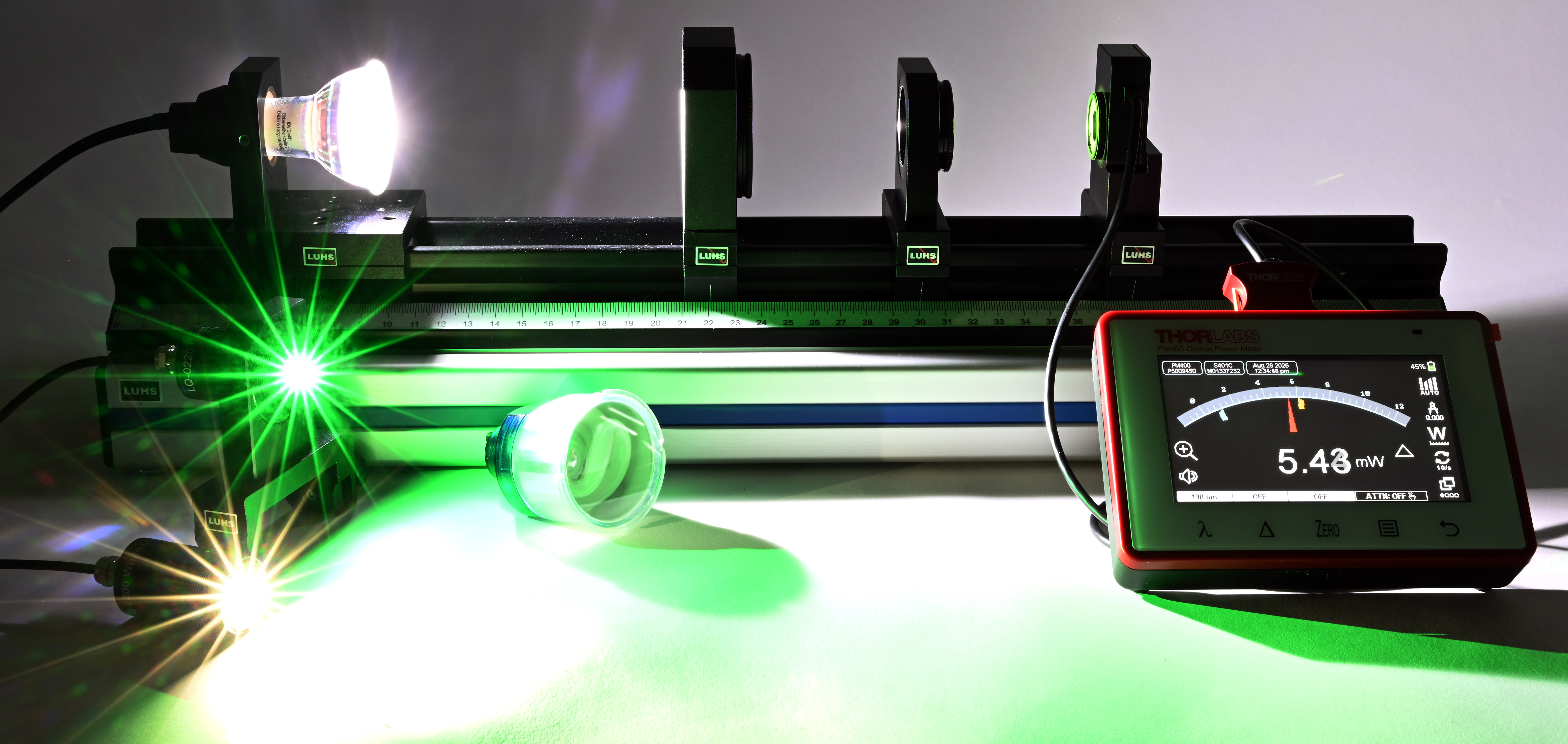 PE-1300 Radio-and Photometry of Light
The values of optical radiation are usually measured in radiometric units as watt seconds or watts, however, the visible part of optical radiation has its own photometric units with a basic unit known as candela (cd). It is the sixth unit apart from the basic units length (m), mass (kg), time (s), electrical current (A) and temperature (T), which were defined during the 10th International Conference for Weights and Measures in 1954. All these units have an official measure which is standardised worldwide by calibrating institutes.
The length for example, was for a long time defined by the primary standard meter in Paris, now it is defined by how long it takes light to pass through 1 meter in vacuum multiplied by the fixed speed of light in vacuum. The standards for mass, time etc. are also well known. However, the units in light engineering are not as common to us since we do not come across the measurement in our daily lives. These units however are indispensable in the preparation of lighting equipment for the various kinds of places people inhabit. In optical science the whole optical, spectral range of radiation is taken into consideration, which covers a wavelength range of 0.2 mm to approx. 1 mm.
In light engineering or photometry however, only the range that can be perceived by the human eye is of interest. Since the sensitivity of the eye is a subjective unit, the International Commission for Lighting has defined the curve of the spectral response of the human eye V(λ). Several measurements were taken on people to obtain a statistical result for this purpose. Photometry considers the subjective spectral response (sensitivity) of the human eye combined with strict physical rules. The sensitivity of the human eye is the measure of all things in photometry. Within this experiments the basics of light are given in the comprehensive manual. The black body radiation is discussed in detail as well as the transition to photometric units.
The key component of the experiment is the V(λ) filter which is designed in such a way that it represents the sensitivity curve of an average human eye. The experiments comes with three LED with different spectral emission, an energy saver and incandescent lamp both having the same electrical power. An almost wavelength independent optical power meter is used to measure the power with and without V(λ) filter. From this measurements the optical power in radio- as well as photometric units are measured.
For many decades—or even a century—incandescent light bulbs have illuminated the night. However, they have also consumed a great deal of electrical energy, and in discussions about energy conservation, incandescent bulbs have come under scrutiny, especially since alternatives exist that offer a better ratio of visible light output to electrical power consumption. Theoretically, an incandescent light bulb converts all of its electrical power into light, albeit across a broad spectral range, similar to a blackbody radiator. However, only a fraction of that light is visible to the human eye.
The basic idea behind this experiment is to create an artificial eye that has the same spectral characteristics as the human eye. To do this, we combine a so-called V(λ) filter with a calibrated power meter. A V(λ) filter is designed to have the same spectral transmission curve as the spectral sensitivity of the human eye.
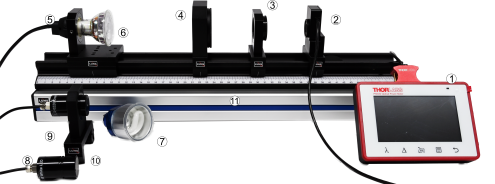
Experimental Set-Up
The artificial eye conists of the V(λ) filter (3), the sensor (2), and the display (1). The lens (4) focuses the light from the light source under examination. The intensity is then measured with and without the V() filter. This ratio can be used to determine energy efficiency. The measurement with the V() filter allows for conversion to photometric units (lumens). There are 4 different light sources (6–9) available.
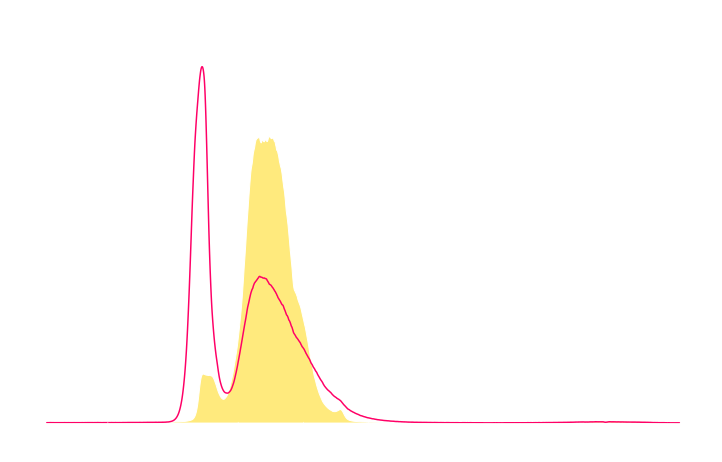
Spectrum of a white LED with and without a V(λ) Filter
If a spectrometer is available, one can record the spectrum of the light source under investigation. One then applies the V() filter and measures the resulting spectrum. This makes it possible to determine which parts of the light source’s spectrum are perceptible to the human eye.